VertaaUX
UX and accessibility auditing platform for dev teams who treat accessibility as craft, not compliance.

Process
Research & Strategy
- UX audit methodology
- Competitive analysis
- User research
- Market positioning
AI Model Development
- Predictive models
- Scoring algorithms
- Validation testing
- Performance optimization
Brand Identity
- Logo design
- Visual language
- Brand positioning
- Identity system
Product Design
- UI/UX design
- Interaction patterns
- Dashboard design
- User flows
Why This Matters
UX Audits Are Slow and Subjective
Most digital products fail because the experience is confusing, unclear, inaccessible or unoptimized. Traditional UX audits are slow, expensive, manual and often inconsistent.
VertaaUX compresses that timeline into seconds, delivering actionable UX direction without heavy consulting overhead.
Diagram text alternative
- Time and cost
- Audits take two to four weeks.
- Audits cost between 5,000 and 50,000 US dollars.
- They require UX specialists and create scheduling bottlenecks.
- Inconsistency
- Results depend on subjective opinions and reviewer bias.
- Scoring is not standardized, which makes comparisons difficult.
- Limited scope
- Manual reviews sample rather than cover the whole product.
- They can miss edge cases and do not update in real time.
- Actionability gap
- Recommendations can be vague and unprioritized.
- Return on investment and implementation steps remain unclear.
The Approach
AI-Driven UX Analysis
The technical foundation combines predictive modeling with real-time analysis, running 90+ automated checks in under 30 seconds. This is 25x faster than initial performance targets, with simple sites completing in just seconds.
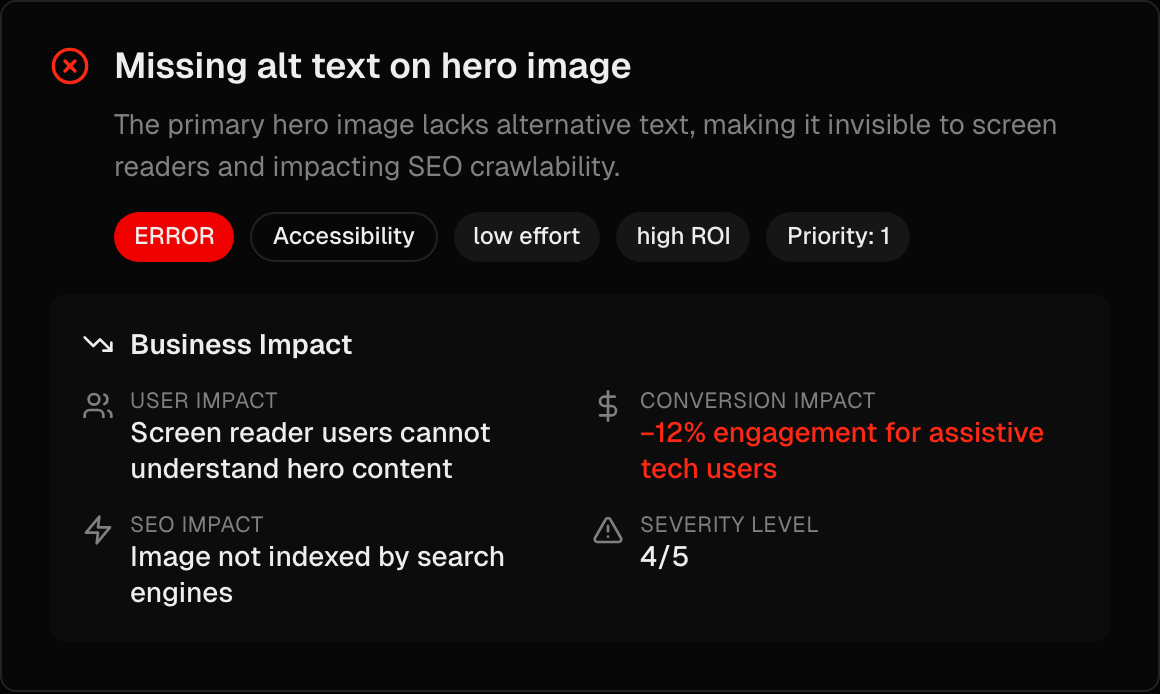
The hierarchical AI system coordinates specialized agents for each audit dimension, producing severity-weighted findings that help teams prioritize by business impact rather than arbitrary severity levels.
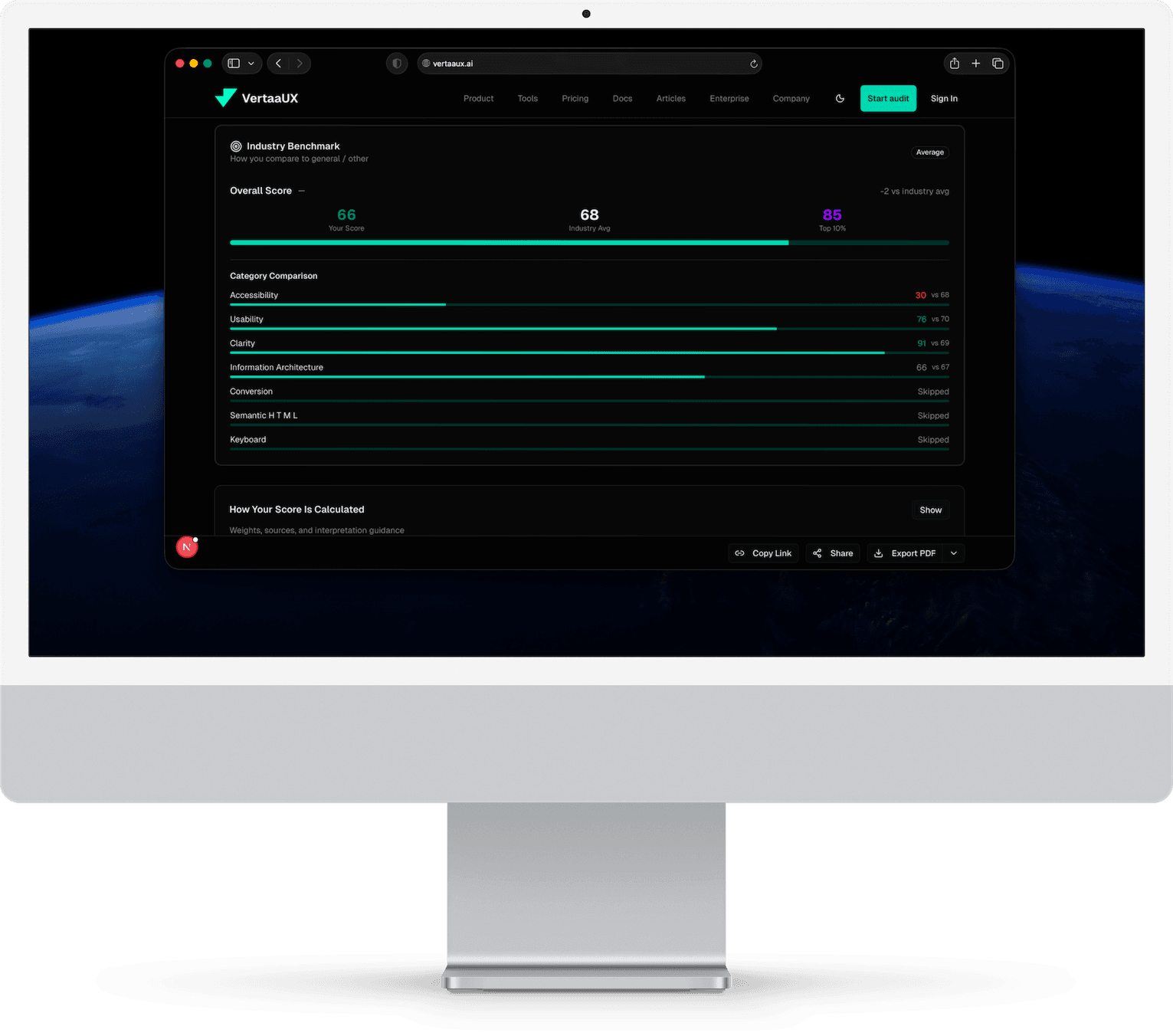
Audit results with severity-weighted findings across seven dimensions.
How It Works
Seven Audit Dimensions
The engine analyzes pages across seven key dimensions: usability scoring based on Nielsen heuristics and cognitive load, clarity analysis including visual hierarchy and CTA effectiveness, information architecture assessment and full WCAG 2.2 accessibility compliance checking.
Each dimension produces a 0-100 score with severity-weighted findings, enabling teams to prioritize fixes by impact. The hierarchical AI system coordinates 15+ specialized agents to deliver comprehensive coverage that would take human reviewers days to complete.
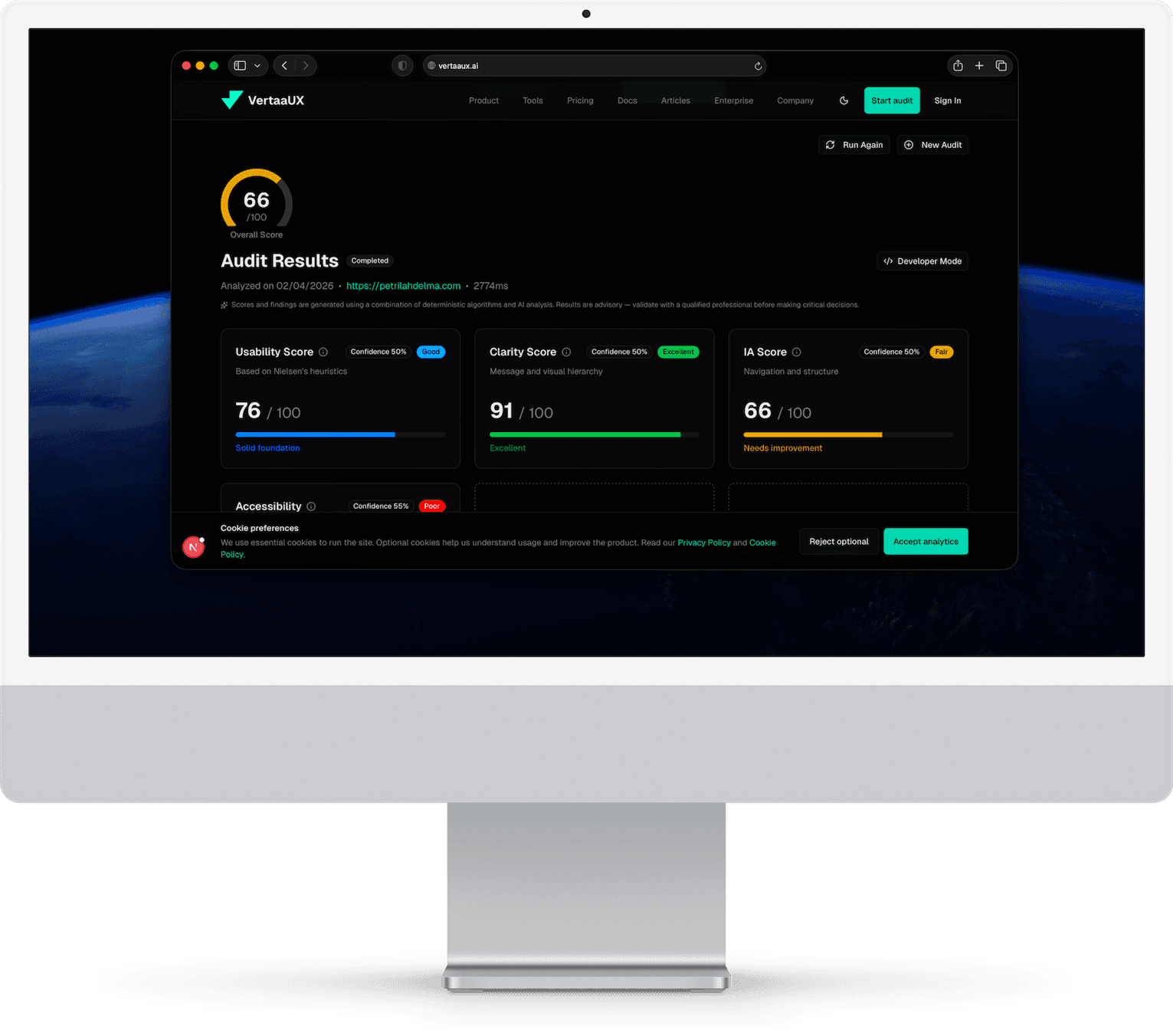
Detailed analysis — severity-weighted findings with inspectable evidence.
Brand Identity
Visual Language for UX Intelligence
For dev teams who treat accessibility as craft, not compliance. The brand identity is built on three pillars: Evidence-First (every finding backed by inspectable data), Quiet Confidence (the product speaks through clarity and measured output) and Craft Over Compliance (accessibility as a discipline, not a checklist).
Typography pairs Geist Sans for everything human with Geist Mono for everything data — scores, selectors, code references. The neon teal (#00FFCC) accent is used as a signal color, never decorative. Dark-biased surfaces let the data breathe.








Color
The Palette
Dark-biased surfaces with neon teal (#00FFCC) as a signal color — used sparingly for CTAs, scores and key data. Never decorative. Semantic score states map to Excellent, Good, Fair and Poor with WCAG AA contrast on all surfaces.
Dark theme (Default)

Light theme

Score state colors

Typography
The Type System
Geist Sans for everything human. Geist Mono for everything data. The font pairing has clear semantic roles — Sans for prose, headings and UI labels; Mono for scores, selectors, code references and technical metadata.

Aa
The quick brown fox
Jumps over the lazy dog
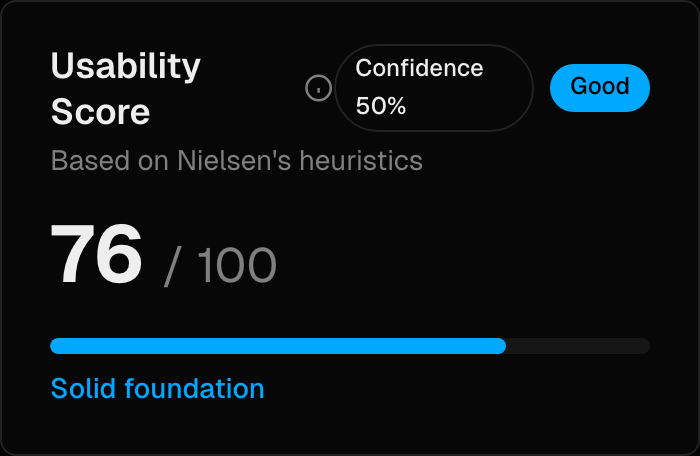
Score 76 / 100 — Solid foundation
Audit completed in 2.7 s, 91 checks passed, 4 dimensions analyzed
ABCDEFGHIJKLMNOPQRSTUVWXYZ abcdefghijklmnopqrstuvwxyz 0123456789
Aa
76 / 100
wcag-2.2-aa
aria-label="navigation"
div.hero > section.cta > button.primary { color: #00E5A0 }
ABCDEFGHIJKLMNOPQRSTUVWXYZ abcdefghijklmnopqrstuvwxyz 0123456789
Interface
The Components
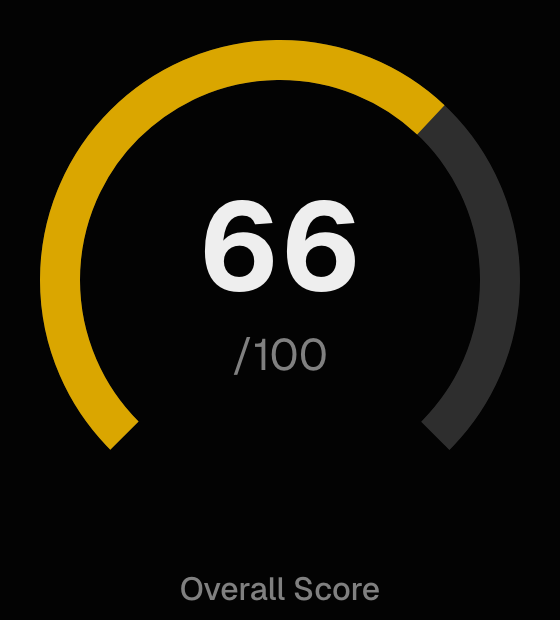
Neon glow as a signature effect on primary CTAs — used sparingly, max one per screen. Score badges, metric cards and issue rows follow a consistent 8px card radius, 4px input radius system.
Product
Dashboard Experience
The interface prioritizes clarity and speed, presenting complex UX data in an instantly scannable format. Users can run guest audits without creating an account or sign in to access audit history, shareable reports and team collaboration features.
Enterprise plans include SAML SSO, multi-tenant support, API access and developer documentation for integration into existing CI/CD pipelines and quality assurance workflows.

Dashboard — audit history, scores and team collaboration.
Key Metrics
Results & Impact
Building the Future of AI driven UX Assessment
VertaaUX.ai launched in 2025 and is now in production. The platform combines comprehensive brand identity design with an AI-powered UX intelligence engine that delivers 2x higher accuracy than industry benchmarks and completes audits 25x faster than original performance targets.
With 91+ automated checks across seven audit dimensions and WCAG 2.2 compliance testing with less than 5% false positive rate, the platform democratizes UX expertise for teams without dedicated specialists. Enterprise customers benefit from SAML SSO, API access and GDPR- compliant data handling.
Interested in working together?
Let's discuss how design systems, AI and thoughtful UX can elevate your product.